Fehringer
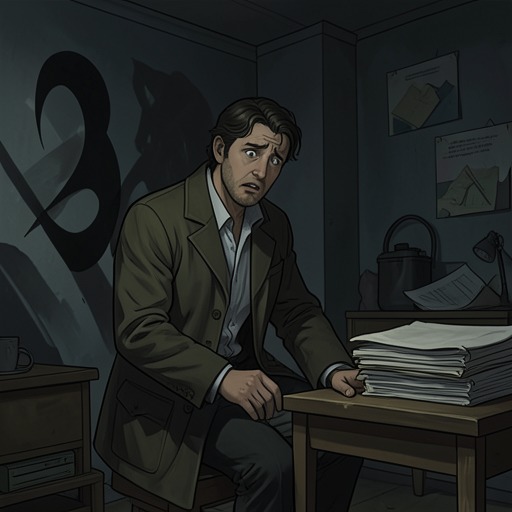
You Should Have LeftFehringer is the local shopkeeper whose seemingly minor appearances become essential to the narrator’s attempt to understand the mountain house. He first enters the narrative through a scene of linguistic and cultural friction: when a very small woman with short white hair and huge sunglasses comes into the store, Fehringer greets her in dialect, a language the narrator cannot understand. The narrator immediately imagines him as material for a screenplay and thinks that Fehringer would be perfect for the role. This response establishes Fehringer as both a person encountered in the world and a figure already being transformed into fiction by the narrator’s professional imagination.
Identity and Introduction
Fehringer works behind the counter of the local general store, a position that places him at the intersection of the mountain community and outsiders who arrive temporarily. The narrator has rented the house through Airbnb and has never heard the owner’s name, so the store becomes one of the few available points of contact with local knowledge. Fehringer’s speech is marked by dialect, and the narrator repeatedly struggles to distinguish what has actually been said from what has merely been assumed. Even the greeting exchanged with the white-haired woman is described uncertainly, because Fehringer immediately lapses into dialect. His local identity is therefore conveyed less through biography than through language, habitual presence, and his authority within the shop.
That authority is not theatrical or expansive. Fehringer does not offer a welcoming explanation of the region, and he does not behave like a conventional guide. Instead, he appears as a tired, guarded local whose knowledge is delivered in fragments. The narrator’s first instinct is to turn his manner into dramatic material, imagining that the actor Steller would have to play him and that the actor Fehringer would be perfect for the part. The scene thus places Fehringer inside a tension between documentary observation and fictional construction: he is encountered as a real shopkeeper, but immediately filtered through the narrator’s awareness of characterization and performance.
The Store and the Warning
Fehringer’s most pointed encounter with the narrator’s script occurs when Jana enters the store with a shopping list. She begins with ordinary provisions—butter, eggs, and bread—but Fehringer interrupts the domestic routine by observing that she is not from there. The narrator revises the line in his mind, rejecting a more polite form of address and a question. What remains is a terse statement, presented as weary observation rather than reproach or inquiry. Fehringer then grunts and goes out, leaving Jana’s face in close-up.
The force of the exchange lies in its lack of explanation. Fehringer does not identify a danger, name the house, or instruct Jana to leave. Yet the narrator interprets the line as a form of warning: Fehringer says it like a regrettable cosmic fact, as though the outsider’s estrangement cannot be corrected. In this way, his minimal speech carries more weight than a conventional exposition scene would. The store becomes a threshold between the narrator’s practical errands and the mountain community’s unexplained knowledge, while Fehringer’s refusal to elaborate makes the warning feel both local and metaphysical.
The Taxi Call and the Geometry of the House
After Esther becomes tired, the narrator searches the kitchen garbage and finds the crumpled bill from Gruntner's General Store, with an address and telephone number stamped at the top. The narrator calls the number because there seems to be no other way to get help. The phone rings five, six, seven times, continues to twelve and then fourteen, and Fehringer finally answers just as the narrator is about to hang up. The delay gives the call an uneasy quality: help is technically available, but it does not respond on ordinary human timing.
The narrator identifies the caller as someone who needs a taxi and says that someone has to come and get them. Fehringer asks who is calling, but the conversation quickly turns to the triangle and the narrator’s earlier attempt to understand what it was meant to show. Fehringer confirms that the elements do not fit together, especially the angles up there. His explanation is not mathematical proof. Instead, he describes an impossibility that has become part of local speech: the angles do not fit, and they never fit. The statement gives Fehringer a distinctive role as the person who acknowledges the house’s abnormal geometry without pretending to master it.
Fehringer attributes the idea to Hans Ägerli, who owns the Lindenhof. Ägerli says that an ant does not know what a cathedral, a power plant, or a volcano is. The comparison supplies a scale of understanding rather than a solution: human beings may be as incapable of comprehending the house’s spatial structure as an ant would be of comprehending an immense human construction. Fehringer also notes that Ägerli has been drinking again and says many things. His qualification keeps the explanation unstable. He passes on the local account while simultaneously warning that its source is unreliable, allowing folklore and skepticism to coexist in the same conversation.
Local History and Vanished Vacationers
When the narrator asks whether there was a different house before the current one, Fehringer answers that there was. It was also a vacation house, inhabited by people who came for holidays and then left, often leaving early. The practical consequence of that history is that Steller always takes payment in advance. Fehringer’s account turns an apparently ordinary rental practice into evidence of a recurring disturbance: visitors do not merely complete their stays and depart according to plan.
He then states that someone disappeared. A vacationer was present, and afterward was no longer there; the person was never found. Fehringer offers a mundane mountain explanation first, suggesting that the vacationer probably fell. The landscape provides ample means for such a death: crevices, smooth slopes, and poorly marked paths. Ägerli is responsible for the mountain rescue service, but he drinks, which makes even the supposed recovery system unreliable. Fehringer’s explanation therefore oscillates between accident and pattern. A single disappearance can be rationalized by the hazards of the mountains, but he adds that people have always disappeared there, including in the past.
The house’s history becomes still older and less verifiable when Fehringer says that, before the old house, there was another one, and that at an earlier time there may have been a tower on the site. He immediately qualifies the tower as legend, but notes that the road is very old. This layered succession—a present house, an earlier vacation house, and a possible tower—makes the location seem less like a stable building than a site where forms recur and replace one another. Fehringer does not claim certainty, yet his fragmented testimony gives the narrator a chronology of instability: the current structure belongs to a longer history of buildings, visitors, departures, and absence.
Narrative Role and Significance
Fehringer is a threshold figure rather than a conventional mentor. He has access to local stories, but he does not decode them fully; he offers warnings, qualifications, and fragments that increase the narrator’s awareness without resolving the danger. His knowledge is practical—he knows the store, the roads, the rescue service, and the customs of vacation rentals—but it also touches the impossible geometry and the legends attached to the site. He stands precisely where everyday expertise meets what ordinary explanation cannot contain.
His characterization is also shaped by the narrator’s unstable act of writing. The narrator hears Fehringer’s dialect, edits his speech into terser screenplay dialogue, imagines an actor playing him, and later relies on his telephone number when escape becomes urgent. Fehringer consequently exists on three connected levels: as a local encountered in a shop, as a voice translated and revised by the narrator, and as a bearer of stories about the mountain house. His most memorable contribution is not a dramatic action but the controlled release of knowledge. By saying that outsiders are not from there, that the angles never fit, that vacationers have vanished, and that an earlier house or tower may have occupied the same ground, he makes the setting’s strangeness historical rather than accidental. The mountain’s danger is no longer only a private crisis inside one rented house; it appears as a recurring local fact that the community has learned to describe without ever fully explaining.